

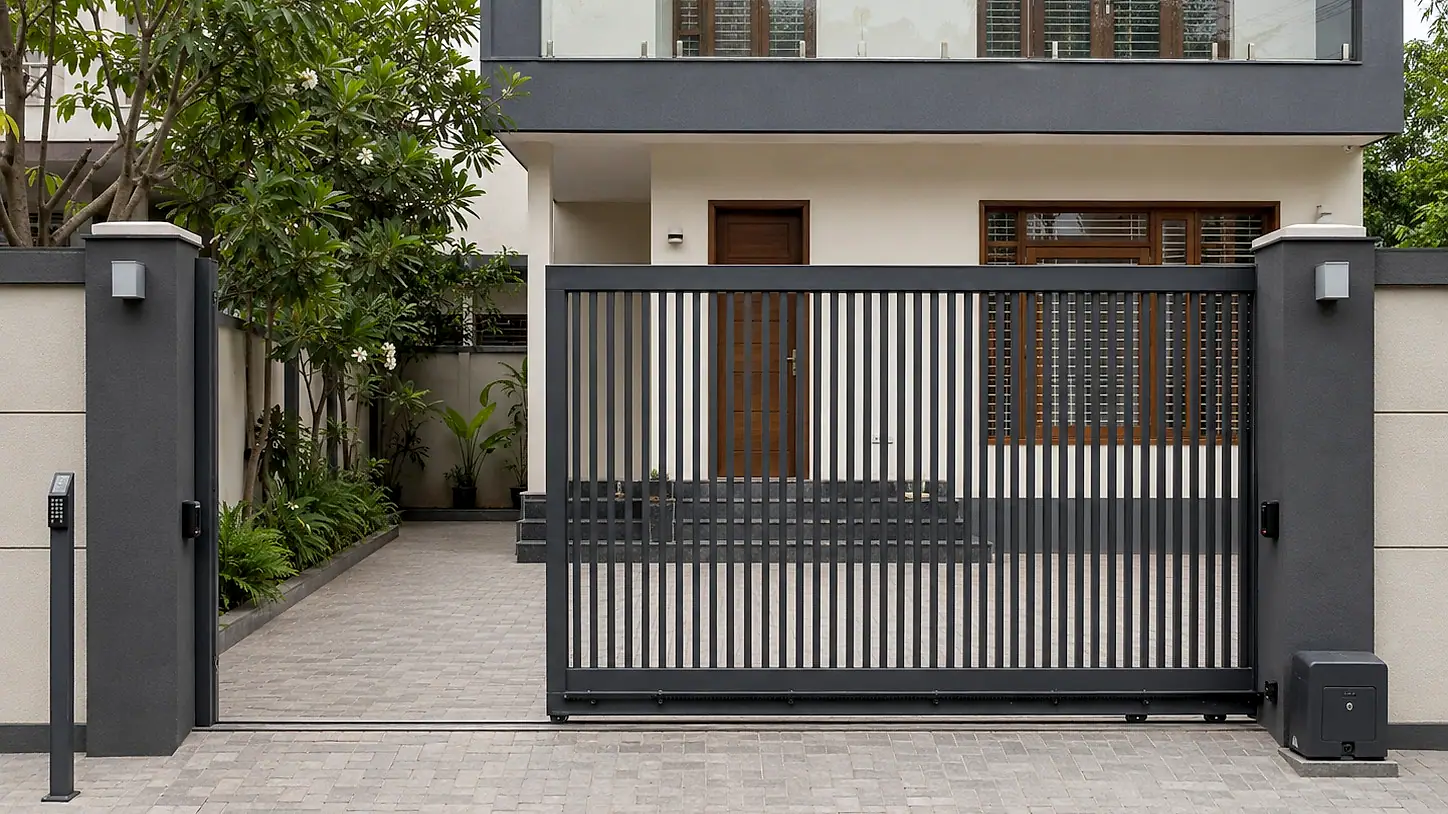
Automation · Gates & shutters
Open it
without touching it.
Remote-operated sliding gates, swing gates and rolling shutters. Fitted to new work, or retrofitted where the existing gate suits it.
Ask before you buy
- Will it work on the gate I already have?
- What happens in a power cut?
- Is my shutter heavy enough to be worth it?
- Can you prepare the gate now and automate later?
Answers are further down this page. If yours is not there, message us and ask.
The gate decides whether the automation lasts
Almost anyone can bolt a motor onto a gate. What makes automated gates fail early is usually the gate underneath, not the motor.
A gate that sags on the hinge side, a sliding gate whose track was set out by eye, a shutter that binds in its guides: all of them work when a person forces them, because a person compensates without noticing. A motor does not. It pushes harder until something gives, and what gives is the motor, the track or the gate.
We build the gate and fit the automation, so both are ours. The gate is balanced, braced and running true before a motor goes near it. If we look at an existing gate and think it is not worth automating, we will say so instead of taking the order.
Three things we automate
Sliding gates
A motor drives the gate along its track on a remote. Track, rollers and frame have to be right first. Automation exposes a badly set-out sliding gate very quickly.
Swing gates
Arms or underground operators swing one or both leaves. Leaf weight, hinge condition and post strength all decide what is suitable.
Rolling shutters
A tubular or side motor replaces manual lifting on shopfronts and godowns. Worth most on wide, heavy shutters opened twice a day.
What people ask us
Can you automate a gate I already have?
Often, yes. It depends on the gate: whether it runs true, whether it is properly braced, and whether the posts and fixings can take the loading. We will look at it and tell you honestly whether it is worth automating or whether you are better off replacing it. A motor fitted to a gate that binds will wear out, and so will the gate.
What happens in a power cut?
Manual override matters, and you should ask about it specifically at quote stage rather than assume it. Tell us how you want the gate or shutter to behave when there is no power and we will specify accordingly.
Is it worth motorising a shop shutter?
It depends on the width and weight of the shutter and how often it is operated. On a wide, heavy shopfront opened and closed every day it is usually the first thing owners say they should have done sooner, both for the time and for the strain it takes off whoever opens up. On a small, light shutter the case is weaker. We will tell you which yours is.
I want automation later, not now. What should I do?
Tell us at the measurement stage. We will prepare the gate and the run so automation can go on cleanly later: correct bracing, a suitable track, and the cabling route thought through. Doing that now costs very little. Reworking a finished gate afterwards costs a great deal more.
Ask about automation
Send a photograph of the gate or shutter and tell us roughly how wide it is. We will tell you whether it can be automated as it stands.